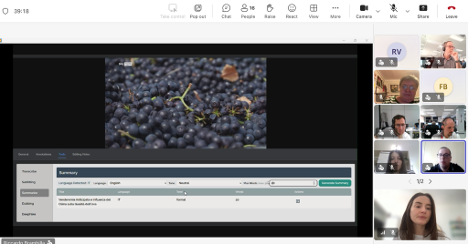
On April 28th, CARSA hosted an intensive mini-hackathon, bringing together a diverse group of experts from broadcasting, academia, and industry in Spain. The event had a dual purpose: to provide a hands-on demonstration of the MOSAIC toolset and to foster a collaborative environment where participants could co-create innovative, practical solutions.
Attendees were divided into three teams, each tackling a challenge tailored to their area of expertise:
- Reinventing Media Accessibility: developing inclusive solutions for diverse audiences.
- Future Media Workflows & Content Production: streamlining and innovating the content lifecycle.
- New Markets and Creative Applications: exploring novel ways to leverage media technology.
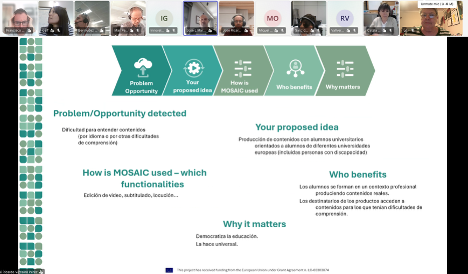
Each group followed a structured problem-solving framework: identifying a specific challenge or opportunity, proposing a solution using MOSAIC’s tools, and defining both the target beneficiaries and the broader impact of their idea.
The Results
Team UAB addressed accessibility with «Educación sin barreras» (Education without barriers), a model where university students use MOSAIC’s subtitling, video editing, and AI voice generation tools to produce multilingual, accessible learning materials. The proposal champions equal access to education while giving students valuable, hands-on professional experience.
Team 3CAT-CMMA tackled the growing crisis of AI-generated misinformation with «Archiving in the Age of AI», a workflow integration that automatically detects and flags synthetic or manipulated content at the point of ingestion. Designed for broadcasters and archival institutions, it addresses one of the most pressing challenges in modern journalism: preserving the authenticity of audiovisual records.
Team INNOVALIA looked beyond traditional media with «VidIA», a tool for cultural institutions, museums, and academics to enrich their audiovisual archives using MOSAIC’s multilingual dubbing, content tagging, and AI analysis capabilities, connecting heritage content with up-to-date global knowledge.
Each team delivered a three-minute pitch, evaluated by a jury across five criteria: innovation, use of MOSAIC capabilities, impact, feasibility, and pitch quality, with an additional ethics and inclusiveness bonus.
The jury’s verdict? All three proposals were recognised equally, a fitting conclusion to a session that proved how a small, diverse group, given the right tools and format, can generate compelling ideas spanning education, media integrity, and cultural heritage in just a few hours.
Final Thoughts
By bridging academia, industry, and media, the event served as a powerful platform for exploring the practical applications of MOSAIC, turning theoretical potential into real-world problem-solving, and showing just how much creative energy can be unlocked when the right people are in the room together.