Since the end of November, the MOSAIC project has entered a crucial validation phase, moving from conceptual design to hands-on experimentation through a series of pilots, focus groups, and individual interviews. Over the past months, 3Cat, the Catalan public broadcaster, has led the execution of pilots based on Use Cases 1, 2, and 3, engaging a diverse group of professional users from across 3Cat News, Accessibility, Digital Assets, Archive and Public Service departments, as well as from cultural institutions such as Sonar and the Gran Teatre del Liceu.
The objective has been twofold: to test the platform in real operational contexts and to gather structured feedback on its value, usability, and future potential.
Executing the pilots
The five pilots were designed to reflect realistic workflows and operational needs within the audiovisual sector and were all grounded in the three Use Cases defined by the MOSAIC consortium, enabling multilingual content distribution, advanced content access and discovery, and content adaptation and enrichment across diverse audiovisual contexts.
The first pilot focused on multilingual distribution workflows, with 3Cat professional users uploading Catalan cultural audiovisual content and generating subtitles and dubbed versions in all languages supported by the MOSAIC platform for cross-border distribution.
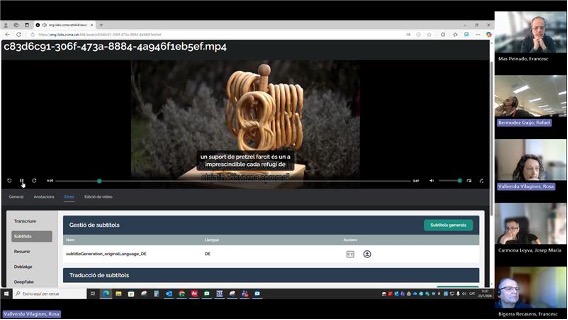
Figure 1 – Execution of Pilot 1 with the participation of 3Cat Accessibility Department
A second pilot explored content discovery in an editorial context, where professional users from 3Cat searched for and discovered climate change–related content using MOSAIC tools, enabling journalists and creators to identify, access, and reuse archived audiovisual material to produce new, contextually relevant outputs.
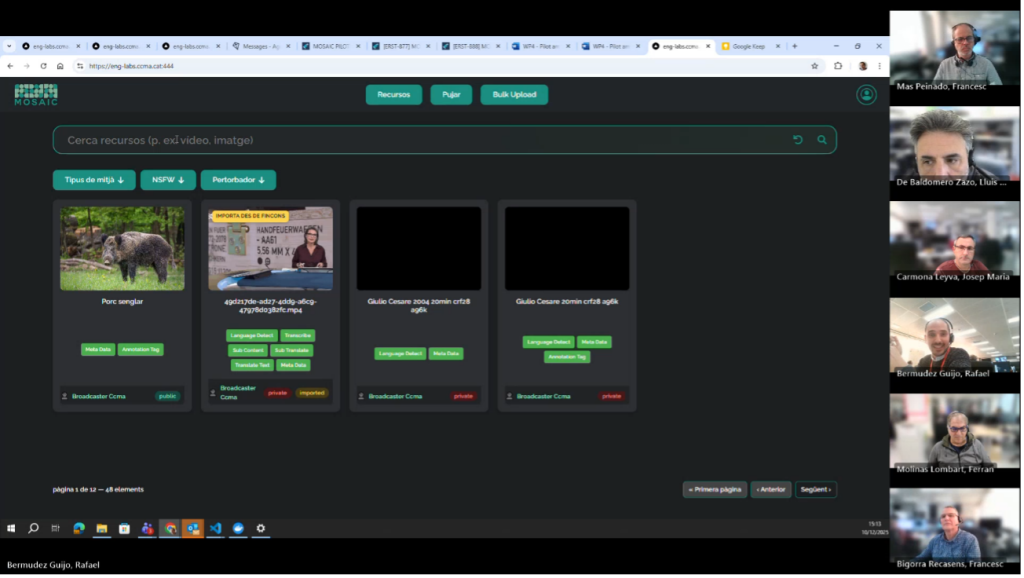
Figure 2 – Execution of Pilot 2 with the participation of 3Cat Digital Assets Department
The third pilot addressed content analysis and enrichment at source, as CCMA professional users uploaded raw footage to be automatically analysed and processed through MOSAIC’s AI-powered tools.
Music-related content and creative reuse were at the core of the fourth pilot, in which professional users from Sónar leveraged MOSAIC tools to search for and discover relevant audiovisual materials, supporting the identification, access, and reuse of archive content for new editorial and creative productions.
Finally, the fifth pilot centered on multilingual access to cultural archives, with professionals from the Liceu accessing audiovisual content produced in collaboration with CCMA to test multilingual distribution workflows. Subtitles were automatically generated in all languages supported by the platform, allowing a direct comparison between MOSAIC-based processes and existing subtitling workflows and technologies.
To execute the pilots, 3Cat had its dedicated private MOSAIC node hosted in a cloud infrastructure and interconnected with the nodes operated by other project partners, such as RTV SLO and SKY Italia, enabling transparent and seamless content sharing among European participants within the MOSAIC ecosystem.
In parallel, 3Cat also deployed a public-facing MOSAIC portal (https://www.3cat.cat/projectes-recerca/mosaic/), providing open access to enriched audiovisual content available in multiple languages, showcasing MOSAIC’s potential to break down language barriers and enhance accessibility for end users across its supported languages.
Across all pilots, participants were encouraged not only to test what the platform can do today, but also to reflect on how it could evolve into a market-ready solution.
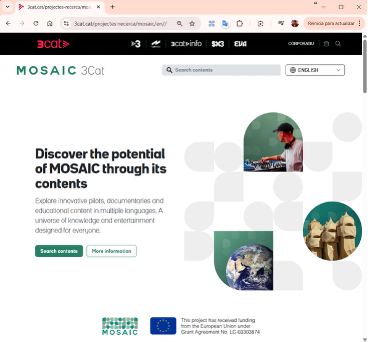
Figure 3 – MOSAIC 3Cat Public platform
Focus groups and interviews: collecting qualitative insights
In parallel with the pilots, several focus groups and individual interviews were organised, bringing together pilot participants from 3Cat, Sonar and Liceu to openly discuss their experiences. These sessions proved essential to contextualize the technical results and capture strategic perspectives.
Participants generally expressed a positive first impression of the platform, highlighting the breadth of functionalities integrated into a single environment. The automatic generation of subtitles and translations was repeatedly identified as a strong value proposition, particularly for non-fiction content, short-form videos, and archival material. Many noted that these features could significantly reduce time-to-market and lower operational costs.
The user interface was described as clear and functional for a prototype, with an intuitive logic for navigating between tools. At the same time, users pointed out areas for improvement, such as simplifying certain workflows, clarifying terminology, and improving performance when handling longer or more complex assets. These comments provided concrete guidance for future iterations.
Business opportunities: B2B and B2C perspectives
Discussions naturally extended beyond usability into business and sustainability models. From a B2B perspective, MOSAIC was seen as particularly promising as:
- A platform for content exchange and collaboration between broadcasters and cultural institutions.
- A tool to support archival reuse, multilingual distribution, and internal production workflows.
- A way to standardise content delivery from smaller partners with limited technical resources.
From a B2C perspective, participants were more cautious but still identified potential, especially if MOSAIC evolves towards simplified user journeys and clearly defined services, and a focused specialization in a well-defined market niche.
Early conclusions and next steps
This article offers only a first snapshot of the feedback gathered throughout the pilots and discussion sessions. Further publications will delve deeper into participants’ insights, platform evaluations, and the emerging opportunities identified within the MOSAIC project.
Overall, the pilots and focus groups confirmed that MOSAIC addresses real and shared challenges within the audiovisual ecosystem. While participants were fully aware that the platform is still a prototype, they recognized its potential to become a scalable solution if technical refinements, rights management mechanisms, and business models are further developed.
These months of testing have transformed MOSAIC from a theoretical concept into a platform grounded in user feedback, operational reality, and market awareness. The insights gathered since November now form a solid foundation for defining the next phase of the project and its possible evolution beyond the research context.